
This is the final part of a three-part series. In Part 1, I built the bear case against MercadoLibre (MELI 0.00%↑) in five pillars: competition is permanently resetting margins, the credit book is growing into a cycle no one has tested it through, macro and geopolitical exposure is real and concrete, the regulatory environment cuts mostly against the company, and a valuation that leaves no cushion for any of those concerns to play out.

In Part 2, I built the bull case in five pillars: margin compression is the Amazon playbook running in real time, the fintech flywheel is a structural arbitrage that regulated banks cannot compete for, ecosystem lock-in is building the layers above the marketplace where the equity value actually compounds, the merchant flywheel has been spinning visibly for a decade and is accelerating, and the valuation is more attractive than the headline multiples suggest once you read the ROIC chart’s recovery pattern correctly.

Where the Debate Sits
The bear and bull cases do not disagree on whether MELI’s ecosystem is generating value. They disagree on who keeps it, and the disagreement runs through all five pillars of the bear/bull exercise.
Both readings are internally consistent. Both are defensible.
Who Actually Captures the Surplus?
The reason this debate matters is because MercadoLibre’s ecosystem is unambiguously creating economic value - the question is who keeps it. In any given quarter, the surplus the platform generates is divided across at least eight stakeholders, and the bear and bull cases disagree only on the direction in which that division is moving over time.
Buyers capture surplus through subsidised shipping (Brazil unit shipping cost is down 17% YoY, which is a direct price transfer to consumers), free returns, and MELI+ benefits. Sellers capture surplus through take-rate discounts and rebates, free promotional placements, and falling fulfillment costs as logistics density compounds. Borrowers capture surplus through NIMAL compression - Mercado Crédito earned 23.3% NIMAL in Q4 2025 and 17.8% in Q1 2026; the spread the lender does not capture goes to the borrower in the form of cheaper credit. Advertisers capture surplus because Mercado Ads is still priced at ~2.4% of GMV against mature peers in the 5-7% range, meaning each advertiser dollar buys more inventory than it eventually will. Employees capture surplus through stock-based compensation and LTRP. Regulators and host sovereigns capture surplus through the $11.5 billion in restricted cash sitting at LatAm central banks, much of it non-yielding in Brazil - interest-free funding for the host country, a real transfer. Competitors capture surplus too: every dollar MELI is forced to match in shipping subsidies or seller incentives is a dollar Shopee, Amazon, or TikTok Shop does not have to spend to keep their own customers. Shareholders are the residual claimant. They capture only what survives the previous seven slices.
Surplus is being deliberately routed away from shareholders today in order to deepen the moats that determine who captures it tomorrow. The bear case is that the routing becomes permanent: every surplus transfer is competed for again next quarter, and the residual never widens. The bull case is that the routing is temporary: each round of surplus given to buyers and merchants returns as volume, retention, and switching costs that allow MELI to take a larger residual once the investment cycle resolves. Amazon’s North America segment is the clearest historical precedent - operating margin ran from 4.1% in 2019 to a -0.9% trough in 2022 before recovering to 7.9% in Q1 2026 - and the recovery only happened once consumers and merchants had been locked in by years of below-cost service. The bear is reading the present slice of the surplus. The bull is reading the trajectory.
The Three Signposts That Will Resolve the Debate
Across the ten pillars laid out in Parts 1 and 2, three single metrics carry most of the analytical weight. Each maps cleanly to one of the load-bearing bull-vs-bear disagreements. Watching them quarter by quarter is the cheapest way to know which side is right.
Brazil unit shipping cost - This resolves whether the logistics flywheel is actually compounding. If unit cost keeps falling YoY in local currency as Brazilian volume scales (-17% YoY in Q1 2026, accelerating from -11% in Q4 2025), the bull case on free shipping as moat construction is being validated mechanically, every additional package is making the next one cheaper, and the network density argument is doing real economic work. If unit cost stops falling, or worse, starts rising as the network saturates, the bear’s reading that the free shipping cut was a margin transfer to LatAm consumers, not an investment with a return, becomes much harder to dismiss. I will watch the local currency YoY number, not the USD number; FX noise distorts the signal.
Credit card 15-90 day NPL direction - This resolves whether the underwriting edge is real or an artifact of an unstressed cycle. The credit card book grew +104% YoY in Q1 2026 while the credit card 15-90 day NPL fell 0.8% YoY, that is exactly the relationship the bull case predicts a data-flywheel-enabled lender to produce. If the NPL line continues to improve or hold stable as the credit card book scales toward a larger share of group revenue, the bull’s data-flywheel argument is being validated. If 15-90 day NPLs spike above 12%, particularly in a Brazilian or Mexican macro downturn, Howard Marks’s “applying standards that were too low and setting the scene for a correction” reading takes over, and MELI gets re-rated as a frontier-markets consumer lender rather than as a quality compounder.
NIMAL stabilization above 15% - This resolves whether the credit book economics are durable as the mix matures. NIMAL fell sharply from 23.3% in Q4 2025 to 17.8% in Q1 2026 as credit card mix rose to 46% of the credit portfolio from 42% year prior. The bull case is that NIMAL stabilizes somewhere in the mid-to-high teens, still 7x what JPMorgan earns on its US loan book, because the structural arbitrage between regulated bank funding costs and under-banked-borrower demand does not get competed away. The bear case is that NIMAL keeps compressing toward the Nubank reference point (9.5% risk-adjusted NIM) as the credit card mix continues to climb and as Brazil’s payment fee compression bleeds through the rest of the fintech P&L. If NIMAL holds above 15% over the next year with a rising trend, the bull’s structural arbitrage argument is being validated. If it keeps stepping down toward 10%, the bear is right that the spread is a transient anomaly.
Final Thoughts
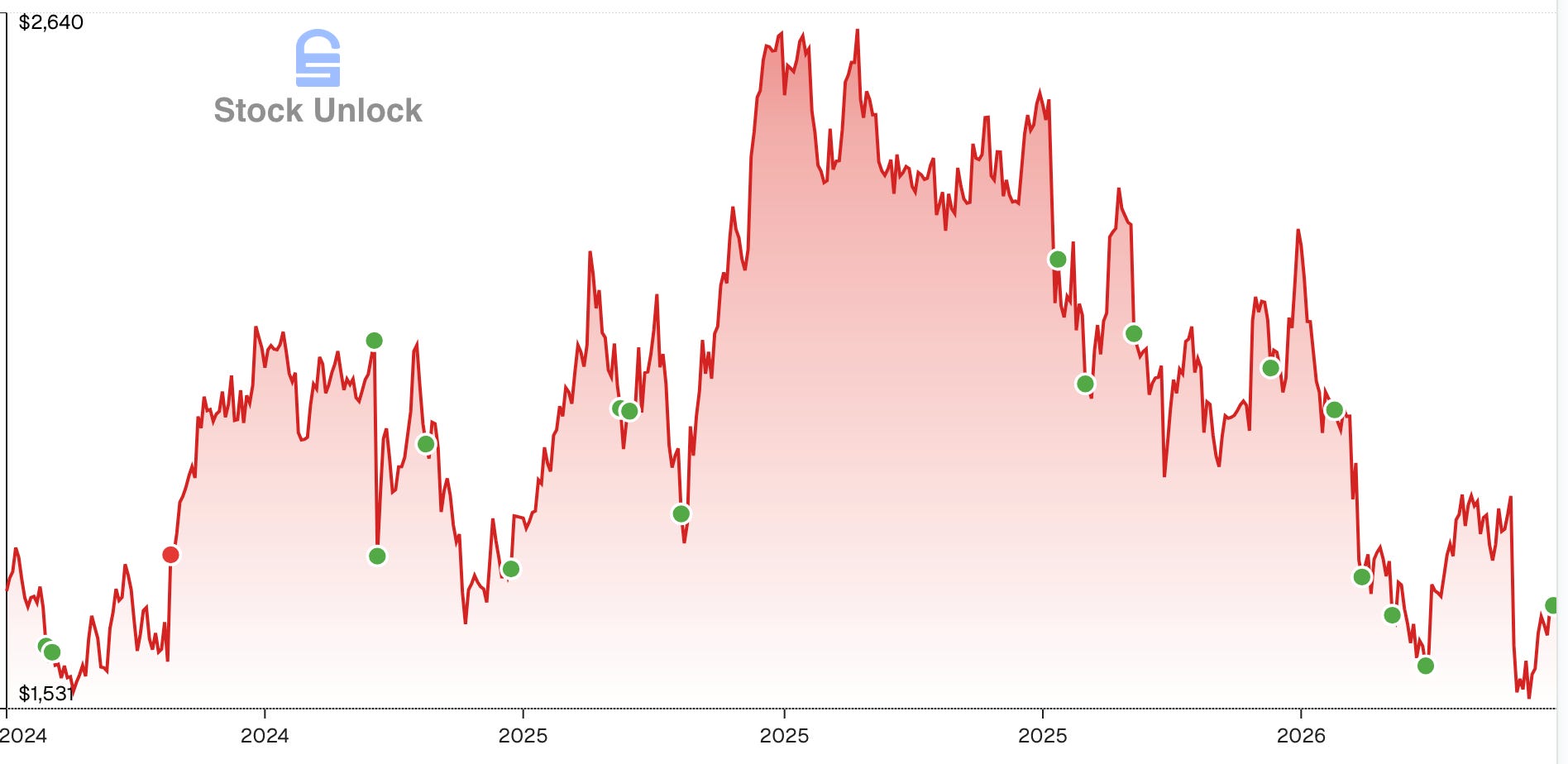
MercadoLibre is a business where the numbers alone do not settle the debate, and the Q1 2026 results gave each side its strongest possible case. Bears can point to a 6.9% operating margin (the lowest since 2022), NIMAL down 5.5% YoY, provisions more than doubling, leverage is 46% up, and a stock down 40% LTM. Bulls can point to revenue accelerating to +49% (the fastest in four years), Brazil items sold doubling in nine months, conversion +1%, unit shipping costs accelerating their decline, cross-sell widening by 9.7%, credit card NPL improving even as the book doubles, and AI-driven productivity for the first time showing up as operating leverage.
My own framing is that MercadoLibre looks less like a company in decline than a company choosing to spend aggressively while returns on incremental investment appear attractive. The key mistake would be to interpret all margin compression as fundamental weakness. Sometimes lower margins are exactly what moat-building looks like in real time.
There is a meta-point worth drawing out across the bear/bull exercise. The bear case in Part 1 leans heavily on extrapolating Q1 2026 forward - present margins, present credit-book growth, present ROIC trajectory - into a structural reset. The bull case in Part 2 leans heavily on extrapolating the decade-long pattern forward: ten years of GMV CAGR through every macro shock in the region, twice running ROIC from negative to over 30%, items shipped up 12x in eight years, GMV up six-fold in nine years. Both sides are extrapolating; the difference is the time horizon they use as the baseline. The market is currently pricing the Q1 2026 results as the baseline. The decade says otherwise.
That is where I land. The 13% selloff on the strongest quarter in four years is, to my reading, the kind of dislocation an investor wants to see in a quality compounder - the market temporarily mistaking moat construction for margin collapse. I do not think MELI is overvalued at current prices and I have been adding to the position through the pullback.
The three signposts above will tell me whether to keep adding, hold, or revisit the thesis. If Brazil unit shipping cost stops falling, if credit card NPL reverses higher, or if NIMAL drops below 15%, any one of those three would force me to reread the bear case more carefully than I currently do. None has materialized so far.
Thanks for the great and robust analysis.
I have a question regarding to the 15-90 day NPLs. In normal days, we may not see the default rate increase significantly even for few quarters or years. But when Black swan comes, the default rate can increase dramatically without any precursor.
Just like the company junk bond market, in normal days or in average, the default rate is low. Then it increase suddently when financial crisis comes.
This will then further affect the NIMAL. So, do you think is there a better way to estimate the concern of "applying standards that were too low and setting the scene for a correction"?
I think the most important factor will be the accuracy and resiliency of the financial model used for the credit business? E.g. when the wider econ fluctuate, how sensitive the NPLs and NIMAL will change?