

The figures come from Amazon’s Q3 2026 results, reported on October 29, 2026, its 10-Q, the Q3 earnings call, and Anthropic’s S-1, filed on October 26, 2026.
After Q3, AWS is growing 39.3% year over year (YoY) at a $184 billion run rate, and Amazon still expects about $220 billion of CapEx in 2026. I priced that plan in Amazon: what the $220 billion CapEx plan returns. The backlog is what turns that plan from a bet into an order book. AWS reported remaining performance obligations (RPO) of $578 billion at the end of Q3 2026, 2.9x the $200 billion of a year earlier. That’s 3.6x AWS’s trailing twelve months (TTM) revenue of $161.4 billion. RPO, the backlog, is spend that customers have committed, primarily on AWS, under contracts with terms above one year. Amazon hasn’t yet recognized it as revenue.

The next question is who signed it. Amazon’s Q3 disclosures size only two commitments, OpenAI’s and Anthropic’s, and name other customers without sizes.
The disclosure stops at one number
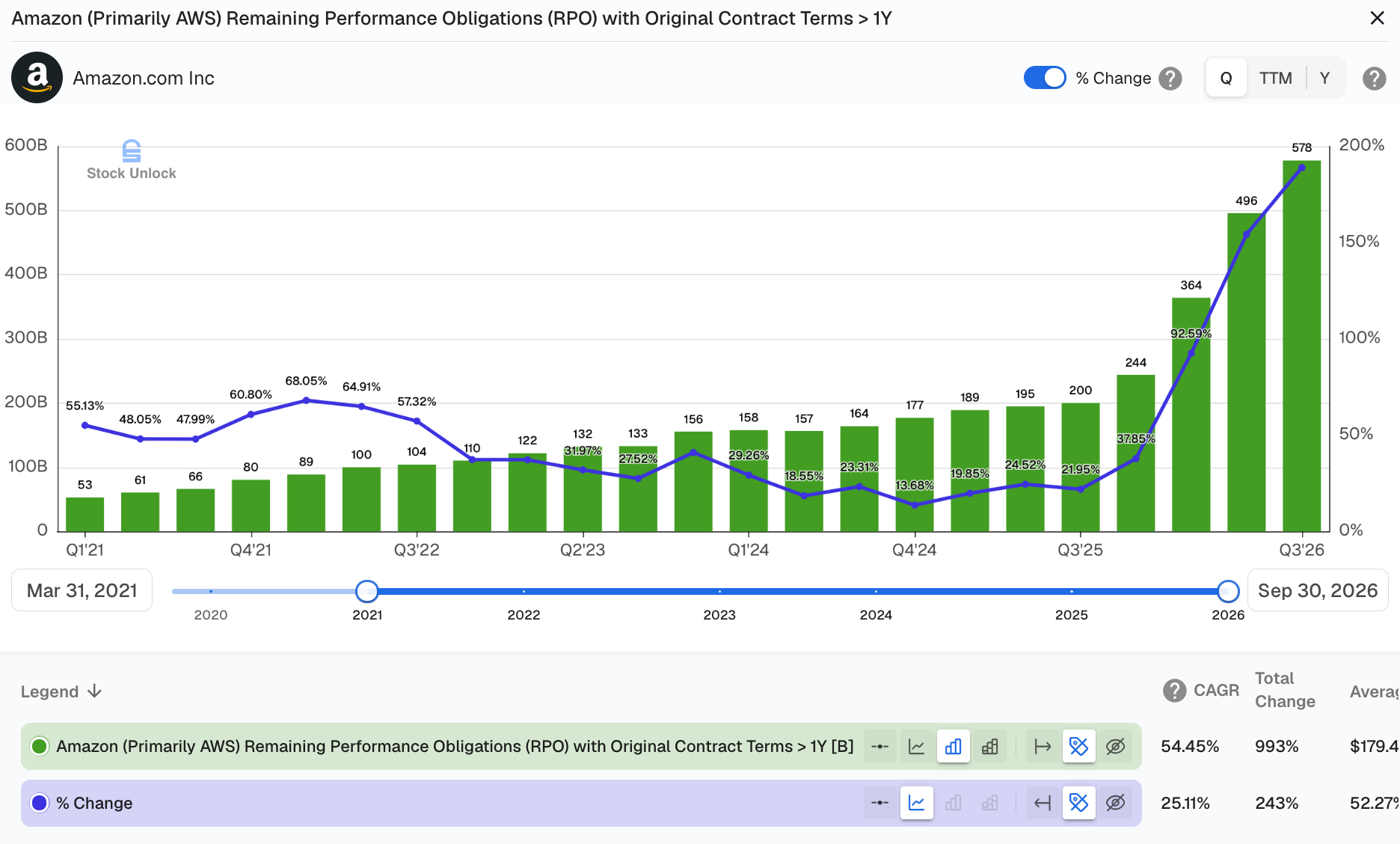
The Q3 10-Q gives one backlog figure and one contract term. There’s no customer concentration note, no industry split and no conversion schedule. During the earnings call, CEO Andy Jassy opened with a mention of the backlog:
“Backlog is $578 billion, growing triple digits year-over-year and well diversified.”
Why the 10% rule catches nothing
US accounting rules only require naming a customer that exceeds 10% of consolidated revenue. On Amazon’s $797.5 billion of TTM revenue, that threshold is $79.7 billion a year. What does it catch? Nothing inside AWS. A customer consuming a third of the AWS segment, about $54 billion a year, still falls short. The test runs against a denominator almost five times the size of AWS, so a customer can dominate AWS and never trigger the disclosure.
Two commitments explain most of the growth
The Q3 10-Q names two commitments, under Unearned Revenue in Note 1:
Q1 2026: AWS and OpenAI expanded an existing $38 billion commitment by $100 billion over 8 years, explicitly including AWS chips.
Q2 2026: AWS and Anthropic expanded their collaboration, which Anthropic’s S-1 puts at $110 billion between May 2026 and April 2036, including Trainium chips.
The backlog grew $334 billion in the first nine months of 2026, and the two deals total $210 billion, 62.8% of it. Q3 alone added $82 billion, and the 10-Q sizes no new commitment behind it. The Q3 earnings release names 23 AWS agreements signed after the Q2 earnings report, “and more”, none sized. One is with OpenAI.
Anthropic’s S-1 shows how firm its share is, on page 171:
“In April 2026, we entered into an agreement with Amazon, pursuant to which we committed to spend an aggregate of at least $110.0 billion between May 2026 and April 2036, regardless of actual usage. If our actual spend falls short, we must pay Amazon the difference as a true-up subject to certain adjustments and exceptions if available. Our commitment under such agreement is non-cancelable except in the event of Amazon’s uncured material breach.”
Add OpenAI’s $138 billion (the original $38 billion plus the $100 billion Q1 expansion) and the two AI labs account for $248 billion, or 42.9% of the $578 billion backlog. The unsized OpenAI agreement from Q3 isn’t in it.
Diversified on revenue, concentrated on backlog
Revenue reflects what customers have consumed. Backlog reflects what they’ve committed to consume.
OpenAI’s $38 billion runs over seven years and its $100 billion expansion over eight, so it averages $17.9 billion a year. Anthropic’s averages $11 billion a year. Together that’s $28.9 billion of estimated AWS revenue a year from 2026, assuming even spending. That’s 15.7% of AWS’s $184 billion run rate, against 42.9% of the backlog.
The bullish reading is that both AI labs have committed to AWS for 8 and 10 years, and Amazon owns appreciating equity in both. The arrangement is circular, and risks reading like a lender underwriting its own borrower. It can break if the labs pay their AWS bills with Amazon’s money rather than their own revenue.
The filings show the loop’s wiring
Anthropic’s S-1 section Convertible Notes and Amazon’s Q3 10-Q sections Non-Marketable Investments and Liquidity and Capital Resources document the loop from both sides:
Amazon funds Anthropic: It invested $8 billion in convertible notes from 2023 to 2025, then $10 billion in preferred stock in 2026.
Anthropic commits to AWS: $110 billion over 10 years, take-or-pay, now in AWS’s backlog.
AWS delivers capacity, and Anthropic can draw more cash: Amazon has set aside $15 billion more. Each time AWS hits a capacity milestone, another $5 billion becomes available.
Amazon’s stake rises in value: Amazon marks its Anthropic stake to the price of each new funding round (table below).
The convertible notes turn into Anthropic shares, but only until Amazon owns 12% of Anthropic, a cap Amazon can waive. The excess stays a loan. The Anthropic S-1 says any balance still unconverted at maturity is repaid in cash or, at Amazon’s choice, “by set-off against certain amounts Amazon owes us under our commercial agreements”. Amazon can net that loan against what it owes Anthropic as a customer.
The S-1 shows Anthropic’s side: It raised $110.4 billion of preferred equity in the first half of 2026, and Amazon’s $10 billion was 9.1% of it.
On OpenAI’s side, alongside its Q1 2026 AWS arrangement, Amazon bought $50 billion of OpenAI preferred stock, 2.8x OpenAI’s average yearly AWS bill by my arithmetic.
The whole $220.7 billion appreciation is Anthropic, because Amazon carries OpenAI at cost. None of it touches Amazon’s operating income or operating cash flow.
Who can pay, and for how long
In my Alphabet’s Q3 2025 results article, I discounted Anthropic’s Google Cloud commitment because it was loss-making. The credit has changed.
Anthropic’s S-1 shows a different company today. Revenue reached $11.6 billion in Q2 2026, against $787 million a year earlier. Anthropic earned $974 million of operating income in the quarter, an 8% margin and its first operating profit. Compute and infrastructure expense fell from 144% of revenue in Q4 2025 to 48%. Cash and short-term investments stood at $131.7 billion on June 30. H1 2026 revenue of $16.3 billion covered $8.9 billion of compute and infrastructure expense, but total costs still ran $693 million above revenue.
Anthropic’s revenue grows so fast that its AWS bill shrinks against it each quarter. Annualized, revenue went from $8.2 billion in Q4 2025 to $18.9 billion in Q1 2026 and $46.2 billion in Q2. Against those, the $11 billion average yearly AWS bill was 135%, 58% and 24%. That share keeps falling only if revenue keeps growing, and the S-1 warns that run rate revenue growth “is expected to decline over time”. Google holds a comparable commitment, $114.5 billion from April 2026, already running alongside AWS. Others ramp up from November. Divided evenly over their terms, Microsoft’s $44.9 billion minimum runs about $1.7 billion a quarter. Broadcom’s $161.2 billion of five-year leases run about $8.1 billion, payable as equipment enters service. SpaceXAI’s $120.5 billion adds about $9.3 billion a quarter from December. Those three alone come to $19.1 billion a quarter, against a $5.6 billion Q2 compute bill. AMD’s first Helios tranche arrives in 2027, above $20 billion over an unstated term.
The risk is the total commitments. The S-1 lists eight compute arrangements under Contractual Obligations, including smaller deals with Nscale and Lambda. The seven with a stated figure sum to $637 billion, about 14x Anthropic’s annualized Q2 revenue. It expects another $125-150 billion of Google’s TPU compute from 2028 to 2031 on top. Ranked by volume, AWS’s $110 billion commitment ranks fourth. The take-or-pay agreement protects the committed spending toward AWS, only while Anthropic can pay it. Revenue covers the compute bill today. With growth expected to slow and the Microsoft, Broadcom and SpaceXAI commitments ramping, whether it keeps covering the bill is the question time will answer.
OpenAI is a different matter. It publishes no accounts. The Wall Street Journal reported Q2 2026 revenue of $6.7 billion and an operating loss of $12.3 billion. Annualized, Q2 puts the $17.9 billion AWS average bill at 67% of its revenue. Against the October run rate near $50 billion, as Bloomberg reported, it’s 36%. Both ratios rest on reports, not filings.
The conversion schedule Amazon withholds
Amazon gives me only a weighted-average term. Its 10-Q states that “the weighted-average remaining life of our long-term contracts is 6.1 years”, which is how long its customer contracts still have to run. Spread $578 billion of backlog evenly across 6.1 years and it converts at $94.8 billion a year, about 52% of AWS’s $184 billion run rate. That’s derived and crude, because the average hides the ramp.
Amazon’s 10-Q adds that AWS growth was “partially offset by pricing changes primarily driven by long-term customer contracts”. AWS discounts its prices for customers that sign long contracts, and those discounts already hold back its reported growth. On the call, Jassy described the visibility those contracts give AWS:
“We have very good visibility into 2027 and 2028 and some of 2029 too, with respect to what customers want in those really big chunks of capacity.”
Final thoughts
Amazon sizes two of the commitments behind the $578 billion, and Anthropic’s S-1 confirms its AWS commitment: $110 billion, take-or-pay, through April 2036. With OpenAI, two AI labs account for 42.9% of the backlog and 15.7% of AWS’s revenue run rate. Jassy’s “well diversified” describes the revenue. It doesn’t describe the backlog.
The concentration sits in revenue Amazon hasn’t yet earned, which is the future revenue Amazon planned part of the $220 billion CapEx plan around.
The S-1 eases my caution on Anthropic without removing it. A company with $974 million of quarterly operating income and $131.7 billion of cash and short-term investments can carry an $11 billion annual AWS bill today. AWS is one of eight compute commitments, though, and the others ramp up just as Anthropic expects its revenue growth to slow. Take-or-pay protects the AWS commitment as long as Anthropic can pay all of its commitments. OpenAI hasn’t filed anything comparable, so I can’t yet size the risk on its half.
Two signposts will tell me whether Anthropic can keep paying its bills, and whether the labs’ share of the AWS backlog is temporary or structural:
Anthropic’s first quarters at full compute load: If its operating income stays positive through Q1 2027, the credit holds. If it doesn’t, Anthropic’s Q2 2026 profit was a gap between revenue arriving and committed compute arriving.
The source of the next $100 billion of AWS backlog: $82 billion added to backlog in Q3, no new sized lab commitment, one unsized OpenAI agreement, and a shorter term. If that holds into 2027, the concentration was a two-quarter artifact. If the next large increment traces to a lab again, it’s structural.
A backlog is a promise to pay. One of the two promisors has opened its books, and they show it can pay today, not yet whether it can keep paying. The other hasn’t opened its books, so its share of the $578 billion backlog is where I stay cautious.